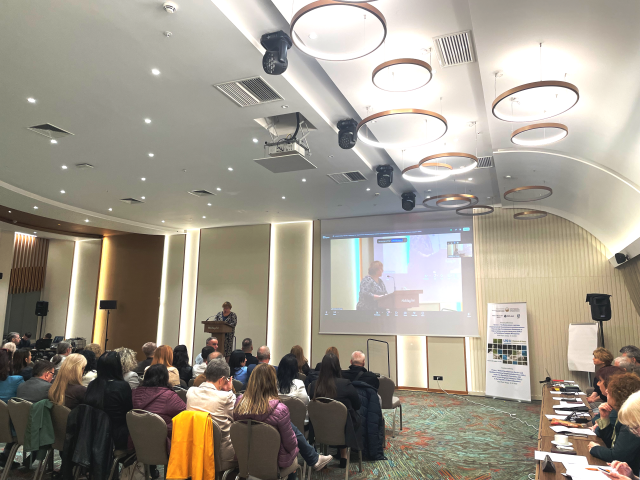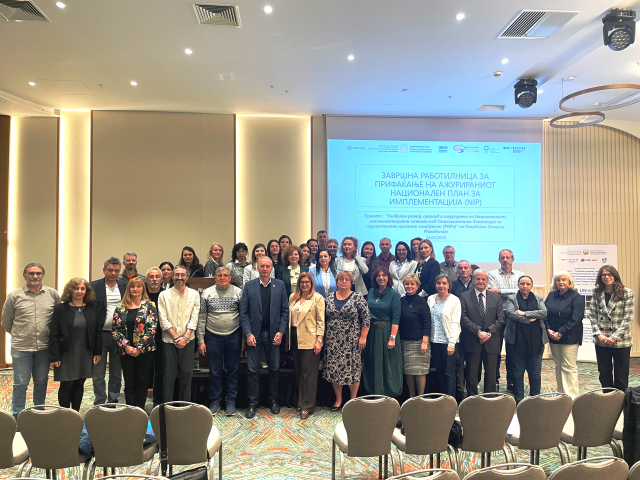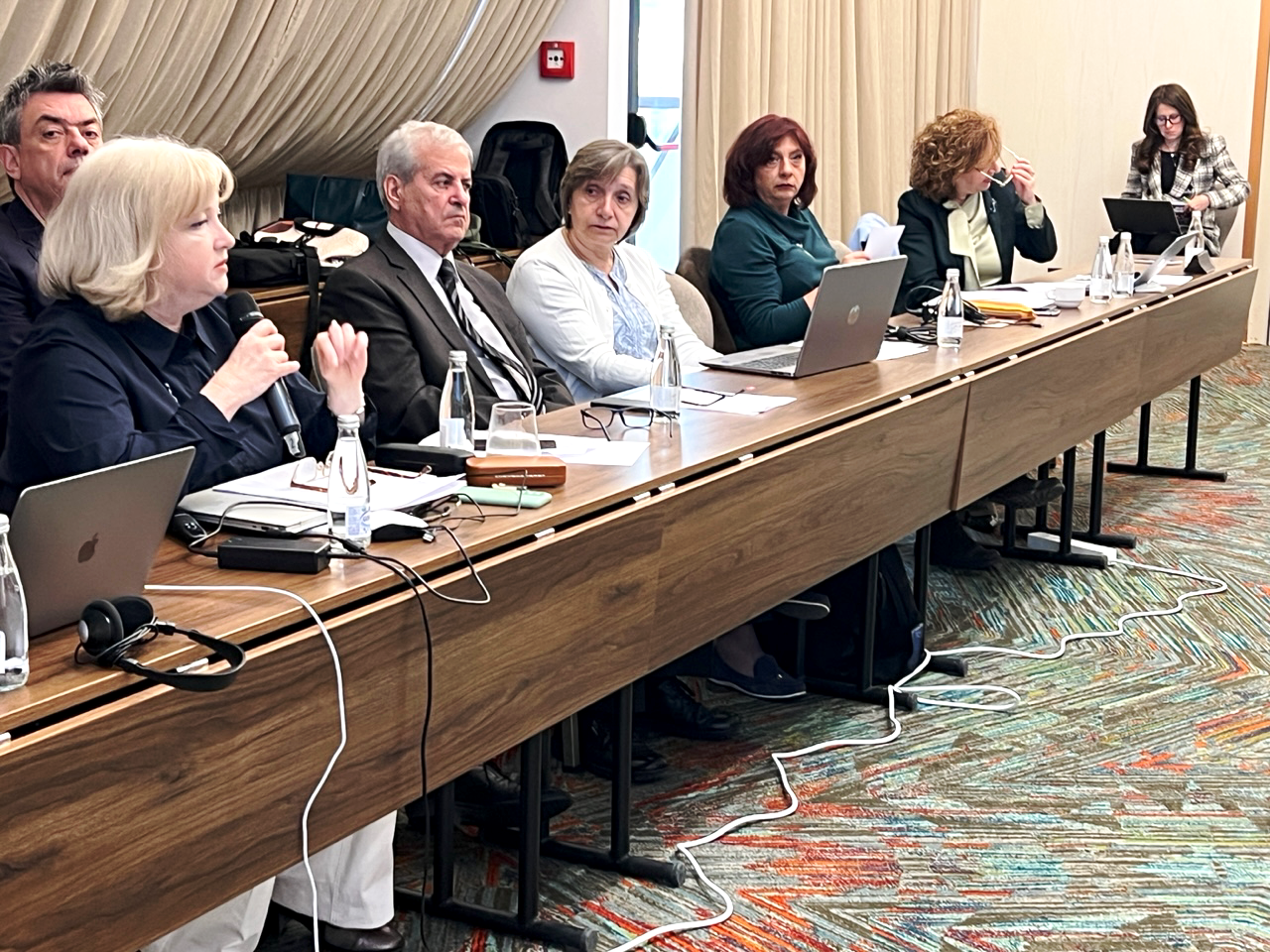
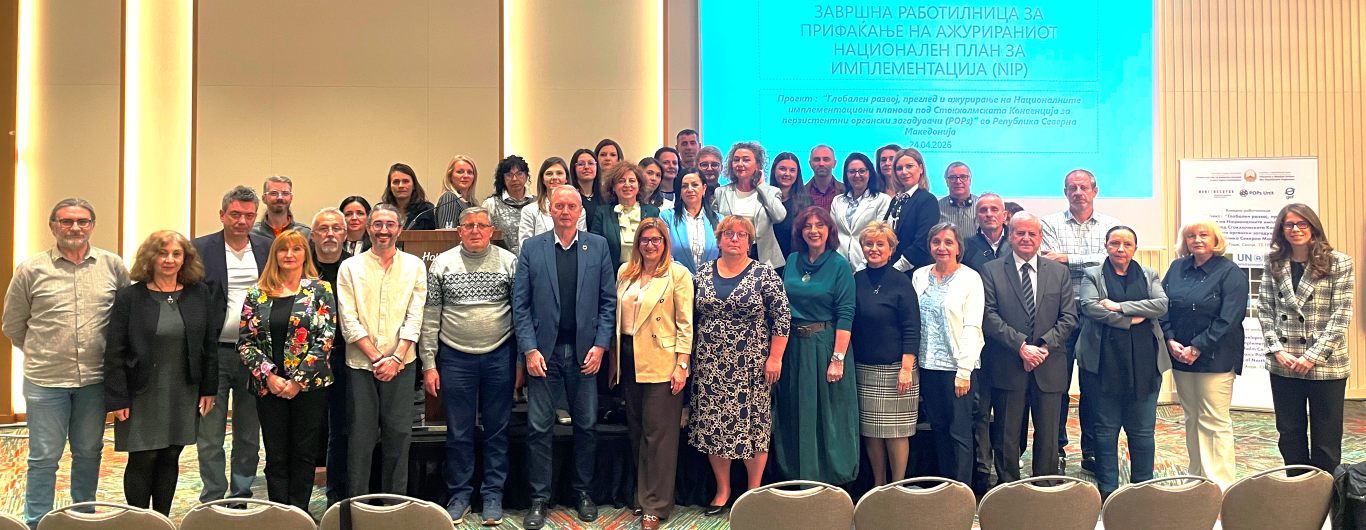
The Ministry of Environment and Physical Planning of North Macedonia (MEPP) in cooperation with the Chemicals and Waste Unit of the United Nations Environment Programme (UNEP) and the Stockholm Convention Regional Centre (SCRC) at RECETOX, Masaryk University, the Czech Republic, on 24 April 2026, at the Holiday Inn Hotel in Skopje, held the meeting for the adoption of the second updated National Implementation Plan (NIP) of the Stockholm Convention (SC).
The multi-stakeholder technical meeting was organised within the framework of the Global Project No. 10785, supported by the Global Environment Facility (GEF) for global development, review and update of national implementation plans under the Stockholm Convention on Persistent Organic Pollutants (POPs) implemented in the period 2023-2025.
The meeting was attended by over 50 representatives from relevant ministries and agencies, research organisations, the industry, civil society organisations, and international partners. Participants were informed about the progress in implementing the Stockholm Convention by the Republic of North Macedonia to date, and the updated priorities, action plans, and activities of the NIP for the appropriate and safe management of persistent organic pollutants (POPs) in Macedonia throughout their life cycle.
In his opening remarks, the National Focal Point for the Stockholm Convention, Mr Aleksandar Mickovski, from the POPs Office, the Ministry of Environment and Spatial Planning, confirmed North Macedonia’s strong commitment to complying with its obligations under the Stockholm Convention on Persistent Organic Pollutants (POPs).
Ms Mihaela Claudia Paun from UNEP joined the meeting via the webcast and congratulated North Macedonia on the successful implementation of the project and the completion of the NIP update, highlighting the complexity, scope and potential for implementation of the proposed priority action plans.
Katerina Shebkova, Director of the Stockholm Convention Regional Centre SCRC, thanked the expert team for their expertise, commitment to identifying practical solutions and seeking quantitative information from various sources that led to a significant improvement in the overall knowledge on the status quo in POPs management, but also to an increased coverage of activities and mapping of future steps through action plans that were shared at today’s meeting.
The expert team, composed of Aleksandar Mickovski, Emilija Kupeva, Slavjanka Pejchinovska-Andonova, Gordana Popsimonova, Trajche Stafilov, Marjan Mihailov, Marina Stefova, Simona Domazetovska Risteska and Suzana Andonova, presented the priority activities to the participants, outlining the key priorities covering all 31 chemicals listed in the Convention for which the preparation of a NIP was mandatory. These proposals, combined into 11 action plans, were discussed and approved by the participants at the meeting.
• Harmonisation of POPs legislation to cover chemicals management and air, water and waste legislation, aiming to prevent further import, use and release of banned chemicals, and to prohibit the import of used EEE and old vehicles with a high risk of the presence of new POPs;
• Provision of training to farmers and agricultural workers on understanding POP pesticides, in order to prevent their use, but also to ensure environmentally friendly management of used PE films used for greenhouses, to reduce emissions of unintentionally generated POPs due to their frequent incineration, although it has long been legally prohibited;
• Finalisation of the phase-out and environmentally friendly elimination of the remaining 4000 pieces of small PCB capacitors (it is expected to contain around 300 tons of PCB based on previous experience);
• Further remediation of already identified contaminated sites in OHIS, Skopje – the small landfill, the large landfill and Pelenica, as a remote landfill where large quantities of lindane isomers are disposed of;
• Identification of locations with new industrial POPs, especially from electrical and electronic equipment and vehicles. A pilot feasibility study will be part of the action plan and tested at four locations;
• Ensuring conditions for identifying the content of PFAS in 6 sectors where PFAS applications are relevant for Macedonia (out of 15 possible applications);
• Management of unintentional POPs releases and preparation of practical guidelines/ methodology for operators and relevant institutions, including a series of training sessions;
• Raising public awareness of the risks and impacts of POPs and conducting regular training for relevant stakeholders;
• Establishing regular monitoring of POPs in the environment and in human biomonitoring, while it was emphasised that air monitoring is restarted in Skopje in 2024, and this will bring the first results for new POPs.
At the end of this event, the Director of the Regional Centre for the Stockholm Convention on POPs, Katerina Shebkova, added: “The prepared updated NIP and action plans focus on a well-organised and practical way of systematically collecting information on new POPs and preparing the country for future, more accurate inventories not only with questionnaires, but with real-life data. The set of activities is aimed at improving the management of waste from end-of-life products and equipment containing industrial POPs. It is also encouraging to see that the phase-out of remaining PCB-containing equipment, as well as the remediation of HCH-contaminated sites, are gaining the same importance and demonstrate the continuous efforts for the full implementation of the Convention as outlined in the previous National Implementation Plans.
Finally, I would like to sincerely acknowledge the expert team for the hard work and dedication they demonstrated throughout the project. It was a great pleasure to work with all of you at SCRC in the Czech Republic, and I am incredibly proud of such a successful outcome of this project.”