Using Selected Environmental Indicators, We Tried to Present Both to Experts and the General Public the State of the Environment, Trends, and Progress in Individual Areas by Providing Accurate and Reliable Data.
Information about the state of the environment is always interesting and current. It is a key factor in policy-making and important decisions, and every citizen of the Republic of North Macedonia has the right to know it so they can contribute to the process of improving the situation.
Why Environmental Indicators?
The establishment and development of environmental indicators were driven by the need to identify indicators relevant for monitoring the state of the environment and policy-making, in accordance with the core set of indicators (CSI) of the European Environment Agency, approved and adopted by all relevant bodies in 2004, containing 37 indicators. These indicators aim to answer key questions for environmental policy development.
Properly selected indicators, based on appropriate time series, show key trends and enable quick and appropriate action by all participants in environmental protection. They are particularly relevant for creating environmental protection policies.
The Government of the Republic of North Macedonia adopted the Environmental Indicators prepared by the Macedonian Environmental Information Center in 2008, identifying indicators characteristic at the national level, adopting 40 indicators in 12 chapters.
The development of individual indicators and preparation of the Environmental Indicator Report is a dynamic process, continuously updated and improved. According to the Environmental Protection Law, this basic list of 40 indicators is updated every two years.
Prepared environmental indicators are based on numerical data showing the state, particular characteristics, or dynamics of a phenomenon. Indicators can warn of problems and are useful tools in environmental reporting. They answer key questions for environmental policy development. Due to their clear and data-supported message, indicators are essential tools for monitoring achievement of sectoral policy goals and planning effective environmental protection and sustainable development policies.
Classification of Environmental Indicators
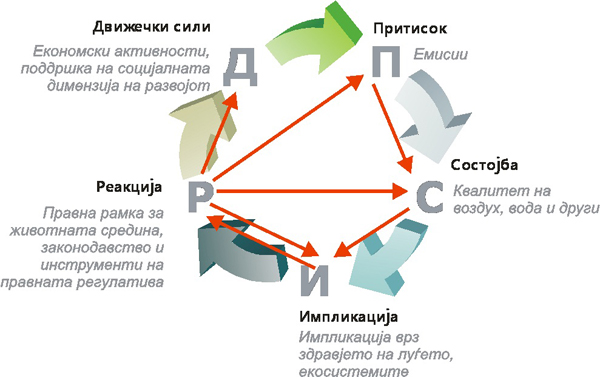
All indicators are arranged according to the DPSIR framework, which covers the following concepts: Driving forces – Pressures – State – Impact – Response, each phase conveying its own meaning (see Figure 1). This framework is particularly important and clear for environmental policy-making.
-
Driving forces are social and economic factors and activities causing increased or mitigated environmental pressures, such as economic or transport activities.
-
Pressures refer to direct anthropogenic pressures and environmental impacts, such as pollutant emissions or natural resource consumption.
-
State relates to the current status and trends in the environment, determining pollution levels of air, water, and soil, biodiversity, and availability of natural resources.
-
Impact represents effects of environmental changes on human health and other living organisms.
-
Response denotes societal reactions to environmental problems, including government measures (e.g., taxes on resource consumption) and decisions by companies and individuals.
Indicators – Classification by Type
Indicators are also classified into five categories:
-
A = Descriptive indicator (answers "What is happening with the environment and people?")
-
B = Progress indicator (answers "How far is the current state from the set target?")
-
C = Efficiency indicator (answers "Is the quality of the environment improving?")
-
D = Policy effectiveness indicator (answers "How effectively is the official environmental policy being implemented?")
-
E = Overall well-being indicator (answers "Has the overall situation improved?")
Presentation of Environmental Indicators
Each indicator is presented with:
-
Code and name
-
Trend
-
DPSIR classification
-
Definition
-
Units
-
Key policy question
-
Key message
-
Specific policy question (if needed)
-
Assessment
-
Methodology
-
Goals (national and international)
-
Reporting obligations
-
Metadata
-
Relation to other indicators
Quantitative values are mainly expressed annually and shown in charts, tables, and maps, accompanied by explanations about trends, causes, and measures. Each indicator has a symbol showing assessment and trend.
Since an indicator can relate to multiple topics, it appears in all relevant chapters on the Ministry of Environment and Spatial Planning’s website.
Status Update in 2020
For better comparison and trend analysis, indicators were updated between January and November 2020 based on new data.
Harmonization was done with:
-
National priorities
-
EEA core set
-
UNECE and EUROSTAT indicators
-
Sustainable Development Goals
-
Green growth and circular economy indicators
New themes were added, the number of indicators increased, some were merged or deleted, resulting in a total of 117 indicators.